
माछाको रंगीन सपना (Fish’s Rainbow Dream) at Shree Ma.Vi. Mithileshwor Mauhawi, Dhanusha | June 24, 2026
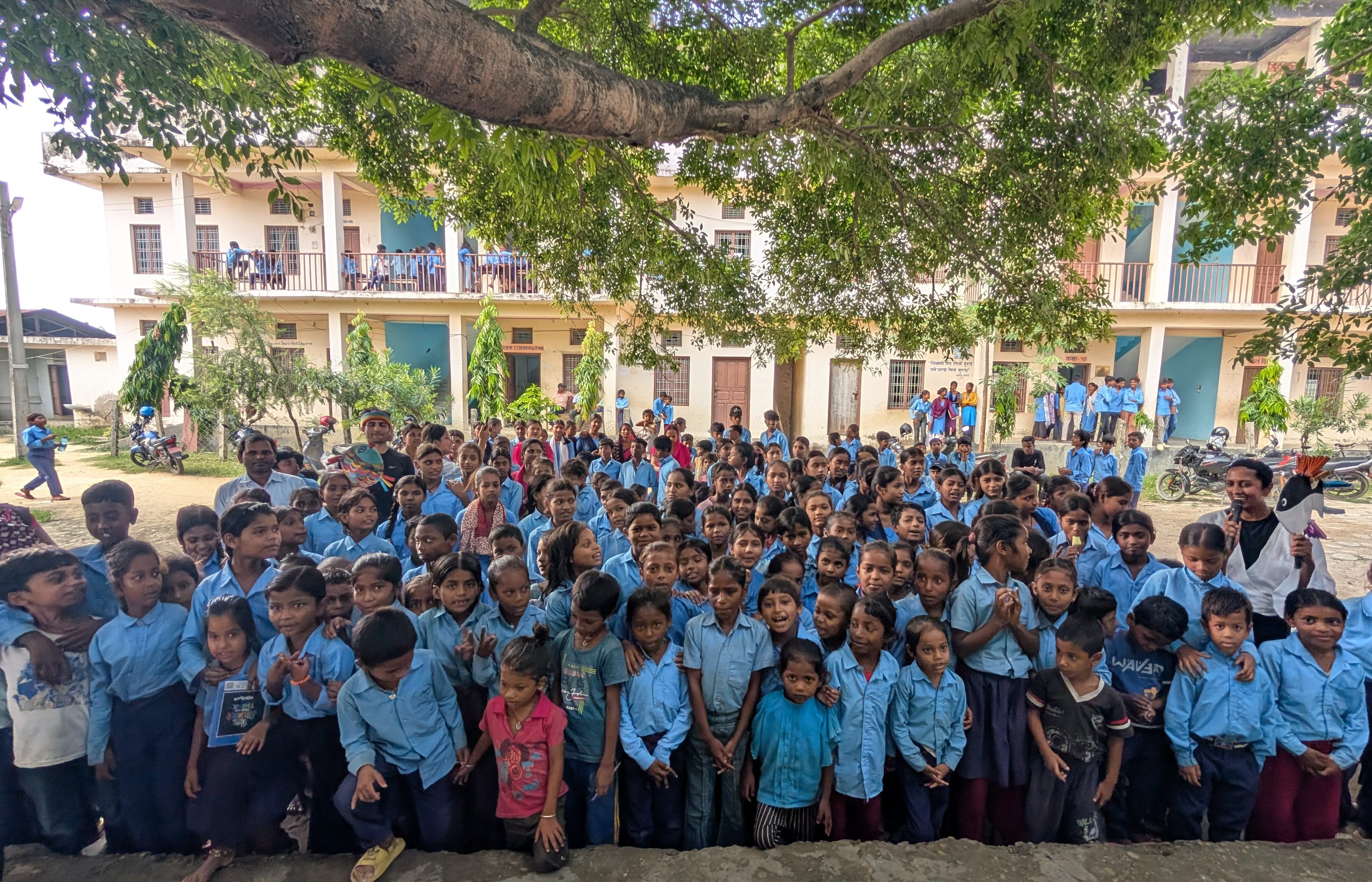
At Shree Ma.Vi. Mithileshwor Mauhawi in Dhanusha, we performed माछाको रंगीन सपना (Fish’s Rainbow Dream) for around 300 children between the ages of 5 -15. For many of them, this was their first experience of a theatre performance designed specifically for children.
What stayed with us was not the number of children, but how involved they became once the story began.
A Theatre Under a Tree
There was no auditorium or conventional stage. A large tree stood in the school grounds, with a raised platform around it. We hung our backdrop between the branches and turned the platform into our stage.
The setting suited the story surprisingly well. Fish’s Rainbow Dream moves through ponds, forests, hills and other imaginative spaces, and the natural surroundings gave the children plenty to look at and imagine.
We adapted the performance to the space and to the audience. Since many children were more comfortable with Maithili than Nepali, we slowed down the pace and allowed more time for them to follow and respond.


When Their Teacher Became the Fairy
The biggest reaction of the day came from an unexpected source—or rather, from someone the children already knew. One of their teachers stepped into the role of the Fairy. At Joy House, we often invite a teacher or parent to play this character. The idea is simple: children don’t need to wait for a magical being to arrive and solve their problems. The people who support, guide and care for them can be their real-life fairies.
But the children didn’t need that explanation. They were simply delighted to see their own teacher suddenly become part of the story. Her appearance brought a burst of excitement and made the story feel even more personal.

The Children Didn’t Just Watch
The performance was built around interaction. Children helped the characters, responded to questions and became part of different scenes.
The fish, crocodile, the orange tree, the sun and the Fairy each gave them something to react to. They were not sitting quietly waiting for the next line. They were constantly being asked to notice, respond, imagine and contribute.
And this was where the hour became interesting.
According to the teachers, some of the children who regularly avoided school or found it difficult to remain attentive in class were completely absorbed in the performance.
We cannot draw a big conclusion from one hour of theatre. But we can notice what happened in that hour.
The children stayed. They watched. They participated. And they laughed together.
That is something worth paying attention to.


A Lesson About Where to Begin
The performance also showed us what we might do differently next time.
If storytelling is unfamiliar to a school community, bringing a large theatrical performance as the first experience may not be the most effective approach.
We would like to begin earlier and smaller.
Short storytelling sessions in classrooms could help children become familiar with listening, responding, imagining and participating. Teachers could gradually build a culture around storytelling before a larger performance arrives.
This could also create an opportunity for teachers to continue using simple stories and theatre techniques after we leave.
Language Matters
Another clear learning was the importance of language.
Many of the younger children spoke Maithili as their first language. Although the visual storytelling, music, movement and props helped communicate the story, language still affected how confidently some children participated.
For future work in Maithili-speaking communities, having a Maithili-speaking performer in the team could make the interaction much stronger.
This is an important part of adapting our work—not simply changing the performance space, but understanding the language and context of the children we are meeting.
The Part We Want to Remember
There is one image from this performance that we want to keep:
300 children gathered under a tree, laughing together while their teacher played a Fairy.
The teachers were not only managing the audience. They were also watching, laughing and enjoying the story themselves.
For us, that was perhaps the most interesting part of the day.
The question was never really whether children can sit still for an hour.
Perhaps the better question is:
What happens when we give them a reason to stay?
About the Story
माछाको रंगीन सपना (Fish’s Rainbow Dream) follows a Black and White Fish who dreams of finding colour. Her journey takes her through an imaginative world of forests, ponds, hills and unexpected encounters. Along the way, the children help her navigate different challenges and meet characters who become part of her search. But at the end, she realizes that all that she was looking for in the world outside, was already present within her.
The performance combines acting, music, handcrafted props, movement, sensory elements and audience participation, allowing children to help shape the story as it unfolds.
Concluding Remarks
This performance reminded us that interactive storytelling can create a different kind of attention—one built not on asking children to be quiet, but on giving them something meaningful to respond to.
It also reminded us that taking theatre to new communities requires more than carrying a finished performance from one place to another. We need to listen to the language, culture, teachers and children of each community and adapt our approach accordingly.
Many Thanks To
- Bindeshwor Yadav – Principal of Shree Ma.Vi. Mithileshwor Mauhawi
- All the teachers and students who participated
- Shishir Siwakoti – in the role of Rainbow Fish
- Bansri Pandey – in the role of Black & White Fish
- Surbhi Darnal – Music and Photography Support
- Ritika Shakya, Karina Thapa Magar – Teaching Fellows from Teach For Nepal
- Madhav P. Devkota and the team of Teach For Nepal
Leave a Reply