
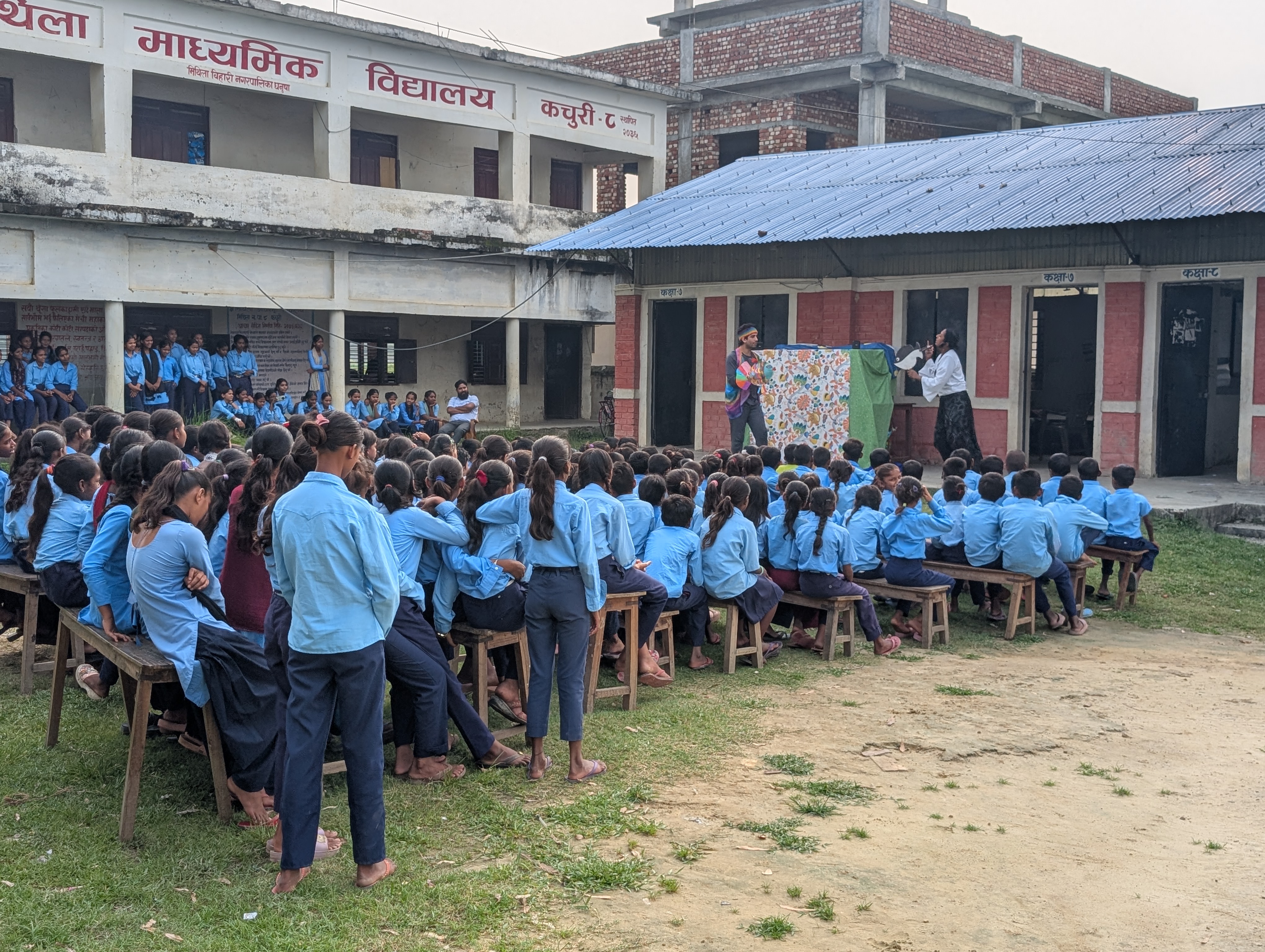
June 23, 2026 | Interactive storytelling performance at Shree Mithila Madhyamik Vidyalaya, Kachuri-8, Mithila Bihari Municipality, Dhanusha
The Joy House Collective presented माछाको रंगीन सपना (Fish’s Rainbow Dream) for almost 300 students from Early Childhood Program to Grade 10 at Shree Mithila Madhyamik Vidyalaya in Kachuri, Dhanusha. The performance was organized with the support of Teach For Nepal fellows and welcomed by the school community as many children experienced a theatre performance created especially for young audiences for the very first time.
Using benches available at the school, cloth backdrops, and simple portable props, the team transformed the school’s open space into a theatrical environment where children, teachers, and performers shared the same imaginative world.

“सो नाटक बाट यस विधालयका विधार्थीहरुले मनोरन्जन प्राप्त गर्नुका साथै विधार्थीहरूमा ध्यान केन्द्रीत गर्ने, स्मरण शक्तिको विकासको साथै बौद्धिक विकासमा समेत सहयोग पुग्ने आशा र विश्वास लिएको छु। तसर्थ यस विधालयको तर्फ बाट आयोजक टिम लाई हृदय देखि धन्यवाद ज्ञापन गर्दछु।” – रामविलास यादव, प्रधान आध्यापक
About the Story
माछाको रंगीन सपना (Fish’s Rainbow Dream) tells the story of a Black and White Fish who dreams of becoming colorful like the beautiful Rainbow Fish. Determined to find colors, the fish begins a journey through rivers, forests, mountains, and magical encounters, meeting new friends who each offer different ideas about where colors can be found.
Along the way, children are invited to help the characters make decisions, solve problems, sing, imagine, and discover that true colors are not something that can simply be collected—they grow through kindness, friendship, courage, and sharing experiences with others. The story combines theatre, music, handcrafted puppets, sensory props, and audience participation to create an immersive storytelling experience for young children.
Stories Can Cross Language
Many of the younger children spoke Maithili as their first language, so some of the spoken Nepali was unfamiliar to them. Yet this did not prevent them from participating. They responded through movement, laughter, gestures, music, and the visual language of the performance.
It reminded us that storytelling for children is never dependent on words alone. When stories invite children to see, sing, move, imagine, and participate, they create connections that go beyond spoken language. At the same time, the experience encouraged us to think about incorporating local languages into future performances so that participation can become even richer.


A Story Built Together
The performance began with warm-up games that quickly transformed hundreds of individual students into one connected audience. Curiosity replaced hesitation as children responded to rhythms, actions, and playful interactions.
The arrival of the Rainbow Fish instantly lifted the energy in the space. Children eagerly answered questions, offered suggestions, and encouraged the characters throughout the journey.
One of the most memorable moments came when the hungry Black and White Fish searched for food. Children enthusiastically suggested everything they thought the fish should eat, and before long, teachers were calling out ideas too. The story became a conversation rather than a performance.
Seeing one of their own teachers suddenly appear as the Fairy brought another wave of excitement. The familiar classroom teacher became part of the magical world, making the story feel even more real for the children and encouraging them to participate with greater confidence.


Continuing the Story Through Art
After the performance, every student received the outline of a fish to colour using their own imagination. The activity allowed children to continue engaging with the story in their own way and carry a small part of the experience beyond the performance.
Why This Performance Was Special
This was the first performance of our Dhanusha journey and an important reminder of why travelling theatre matters.
Interactive storytelling performances are still rare in many rural schools across Nepal. For the children, it was an opportunity to experience learning through imagination, movement, music, and participation. For teachers, it demonstrated another way children can engage deeply with learning when they are invited to become active participants rather than passive listeners.
One performance alone cannot transform education. But it can introduce new possibilities—for children, teachers, and schools—to imagine what joyful, art-based learning can look like.

Concluding Remarks
Every school has its own environment, language, and way of learning. This performance reminded us that meaningful storytelling adapts to the community it visits while staying rooted in participation, curiosity, and human connection.
We hope this visit marks the beginning of many more opportunities for children in rural communities to experience theatre, stories, and creative learning.
Many Thanks To
- Aakankshya Shrestha and Sangita Thapa – Teaching Fellows from Teach For Nepal
- Madhav P. Devkota and the team of Teach For Nepal
- Mr. Ramvilas Yadav – Principal, Shree Mithila Madhyamik Vidyalaya
- All the teachers and students who participated
- Bansri Pandey – Actress in the role of the Black & White Fish
- Shishir Siwakoti – Actor in the role of the Rainbow Fish
- Surbhi Darnal – Music and Photography Support
Leave a Reply