
June 7, 2026 | Kinderjoy Montessori School, Kathmandu
How can a simple storybook become an engaging classroom experience? How can teachers move beyond reading a story and invite children to actively imagine, participate, and connect with it?
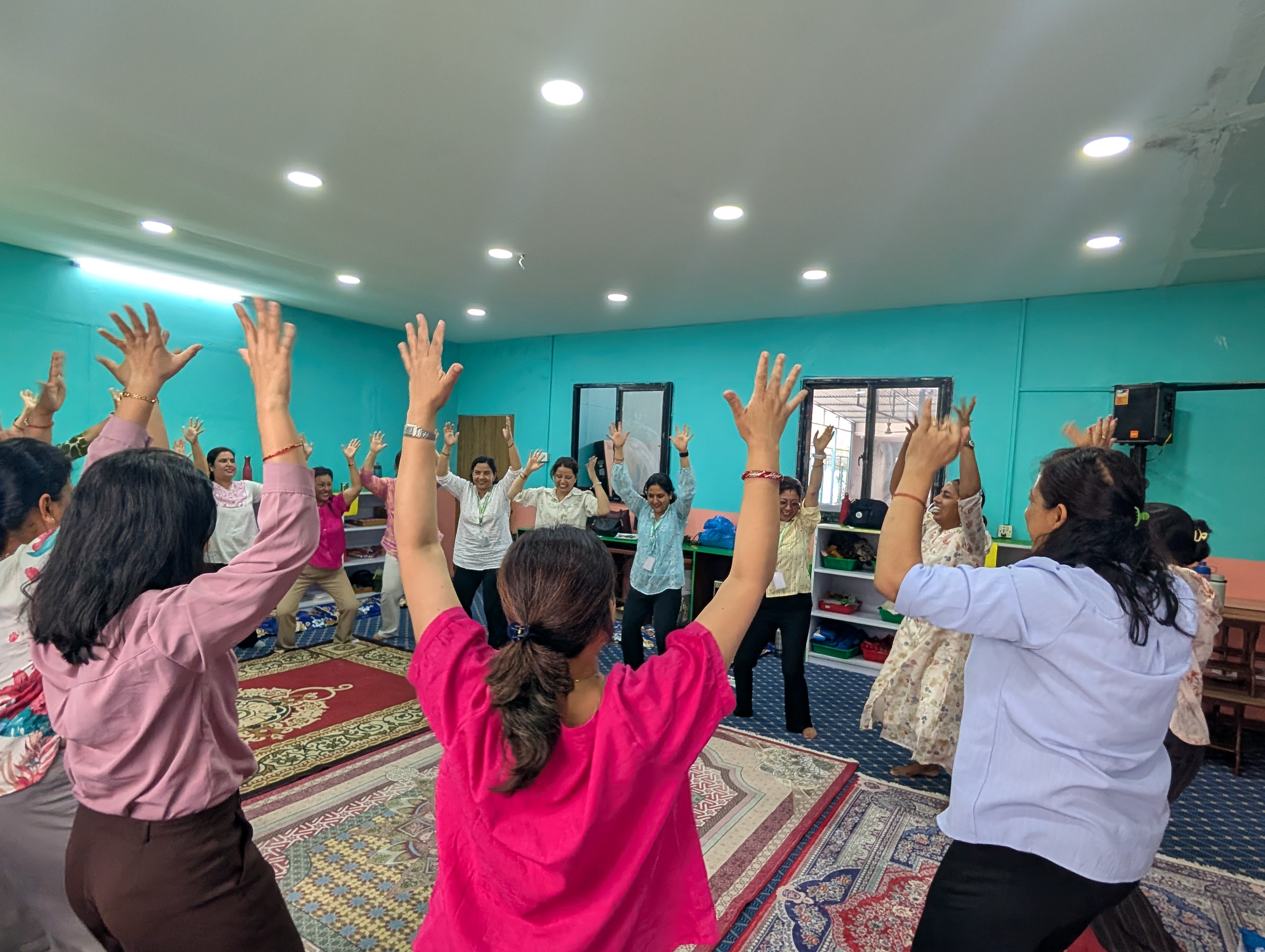
These questions formed the foundation of a six-hour teacher training workshop titled “Storytelling for Teachers – From Page to Stage” conducted at Kinderjoy Montessori School for around 20 teachers from pre-primary and primary grades.
The workshop introduced practical drama-based storytelling tools that teachers can use in their everyday classrooms to make stories more interactive, memorable, and meaningful for young learners.
About the Workshop
Stories are already an important part of early childhood classrooms. This workshop explored how teachers can deepen children’s engagement by using simple elements of theatre such as movement, voice, characterization, setting, dialogue, audience interaction, and imagination.
Using the familiar fable of The Tortoise and the Hare, participants experienced the journey of taking a story from the page and gradually transforming it into a performance. The focus was not on becoming actors, but on discovering practical techniques that help children connect more deeply with stories and learning.
Beginning with Play
The day began with warm-up theatre games designed to build trust, energy, and connection among participants.
Teachers engaged in activities that encouraged observation, listening, creativity, and spontaneous thinking. These exercises also demonstrated how simple games can become effective tools for preparing children to participate actively in storytelling sessions.
The group then read The Tortoise and the Hare together and discussed different drama elements that could be incorporated into a read-aloud experience.


Stepping Inside the Story
Rather than analyzing the story from outside, teachers were invited to enter the story world through Image Theatre activities.
Using body movement, imagination, and group exercises, participants explored the setting of the story, the personalities of the characters, and the emotions behind their actions.
What smells and sounds can you hear in a jungle? What does confidence look like in the body of the hare? How does a tortoise move, think, and respond to challenges?
Through these questions, teachers experienced firsthand how physical exploration can help children understand stories beyond words.


Reimagining the Tale
Participants were divided into four groups and challenged to create their own version of The Tortoise and the Hare.
Each group worked with key storytelling elements:
- Setting
- Characters
- Actions
- Dialogue
- Voice and Body Movement
- Audience Interaction
- Props


The familiar fable quickly transformed into unique interpretations shaped by each group’s creativity and imagination. Teachers discussed possibilities, developed scenes together, and prepared short performances that brought their new versions of the story to life.


From Performance Back to Read-Aloud
After presenting their performances, the workshop returned to the original story. This time, participants revisited the read-aloud using the dramatic tools they had explored throughout the day.
Teachers experimented with voice variation, movement, character actions, audience participation, and storytelling techniques that could easily be adapted for classroom use.
This process helped connect theory and practice, showing how even small changes can make story sessions more engaging and interactive for children.


Experiencing Interactive Storytelling
To conclude the learning sessions, facilitator Bansri Pandey performed a short interactive storytelling experience titled “Mama Cat Has Three Kittens.” The teachers became active participants in the story, responding, moving, and contributing as the narrative unfolded.
Experiencing interactive storytelling from the learner’s perspective allowed participants to reflect on how engagement, participation, and play influence the way stories are received and remembered.

Reflections and Closing Circle
The workshop concluded with a closing circle where participants reflected on their learning and shared feedback with the group.
Throughout the day, teachers collaborated, created, performed, and supported one another. Beyond storytelling skills, the workshop also created opportunities for teamwork, communication, confidence building, and creative exploration.
Most importantly, it demonstrated that meaningful storytelling does not require elaborate resources. With imagination, presence, and a few simple techniques, teachers can transform stories into memorable learning experiences.

The Experience
The training was filled with movement, discussion, laughter, and collaborative learning.
Teachers actively participated in every stage of the process—from games and imagination exercises to devising performances and experimenting with storytelling techniques. The atmosphere remained energetic and supportive throughout the day, allowing participants to take creative risks and explore new ways of working with stories.
The final performances reflected the diversity of ideas within the group and demonstrated how a single story can lead to multiple interpretations when learners are encouraged to imagine and create.

Many Thanks To
- Rita Acharya – Founder of Kinderjoy Montessori School
- All the teachers who participated
- Bansri Pandey – Facilitator
- Surbhi Darnal – Support
Concluding Remarks
Stories are often at the heart of early childhood education. When teachers combine storytelling with movement, imagination, and participation, stories become more than something children listen to—they become experiences children remember.
Workshops like these aim to provide practical tools that help educators create more engaging and joyful learning environments through the power of storytelling.
To learn more about Our Work, please feel free to Contact Us.
Leave a Reply