
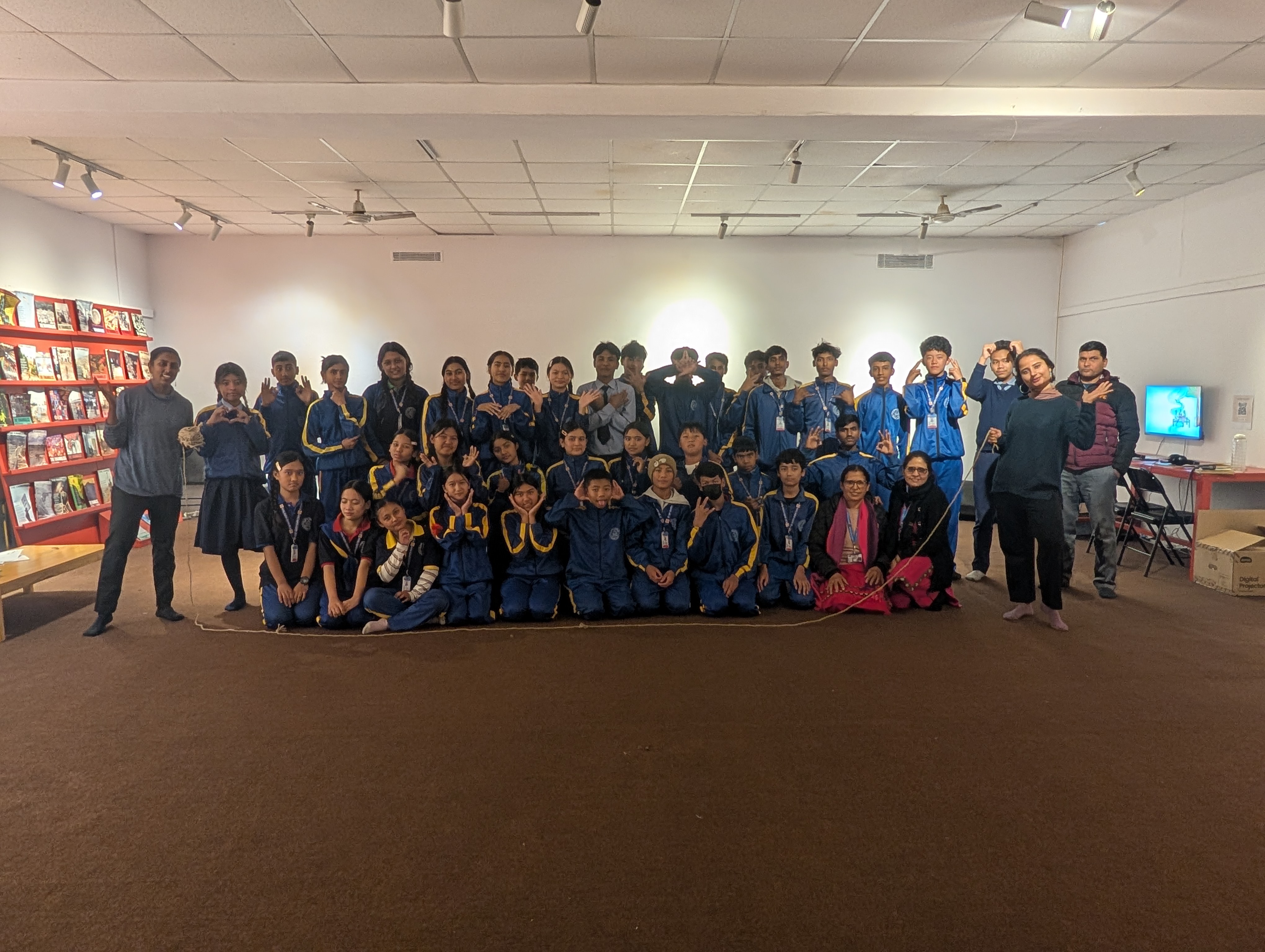
12/11/2025 | PhotoKTM 2025, Nepal Art Council, Babarmahal
On 11th December 2025, 35 students of Shree Yuba Sahabhagita Secondary School participated in an immersive applied theatre workshop at the PhotoKTM festival, hosted at Nepal Art Council, Babarmahal. Facilitated by applied theatre practitioners Gunjan Dixit and Bansri Pandey, the workshop invited students into a creative exploration of resilience, identity, and change.
The Workshop Theme: “Crossing the River”
The workshop was inspired by the book Like a Rising River, published by Srijanalaya with the support of UN Women Nepal and the Government of Finland. The book is a collection of short stories about women from across Nepal who share real-life experiences of gender discrimination, struggle, resilience, and transformation. Through honest storytelling, the book highlights courage, change, and the quiet strength of individuals who navigate and overcome societal challenges.
The workshop revolved around the metaphor of a river. What does a river represent in our lives? Is it a conflict, expectation, fear, or a narrative we wish to break? What does it mean to cross it—and what lies on the other side? Possibilities, uncertainty, hope, or new beginnings?
Through theatre-based tools, students were invited to reflect on these questions and explore their own journeys.

Workshop Modules
Warm-Up & Connection
The session began with energizing theatre games to build trust and comfort among participants. These activities not only created a safe space for students to feel engaged but also encouraged openness and connection.


Session 1 – Crossing into Imagination
A rope was placed across the room, reimagined as a river. One side represented real life; the other, an imaginary world filled with everyday objects. Students were invited to “cross the river” and select an object, reimagining its purpose—a pencil became a rocket ship, a ball transformed into an apple, paper turned into a train flag.
This activity sparked creativity and embodied expression. Students used their bodies to represent their imaginative interpretations, stepping confidently into a space of play and exploration.


Session 2 – Image Theatre & The Flooded Homes
Using Image Theatre techniques, students worked in groups to create still images representing prompts such as a tree, house, furniture, and a document. Through teamwork, they built collective body sculptures to express these ideas.
The rope returned—this time forming a rectangular river dividing the space. Some “homes” were flooding while others were safe. Students had to decide: Who do we rescue? What do we protect? How do we act before the river rises?
Communication, leadership, and critical thinking naturally emerged as they navigated this simulated crisis together.


Session 3 – Stories from Like a Rising River
Students watched narrated videos of two stories from the book: लताको फोटो स्टुडियो (Lata’s Photo Studio) and रातमा ब्युँझिने सपना (A Dream that Wakes at Night). Through guided discussion, facilitators connected the metaphor of the river to the real-life challenges faced by the women in these stories.
Students reflected on what “crossing the river” meant for the characters—and began to consider the rivers in their own lives.


Session 4 – From Conflict to Change
Divided into groups, students shared personal challenges and each group selected one story to explore further. Using Image Theatre, they created three images:
- An image representing their current challenge.
- An image of their ideal future or solution.
- An image showing what must change in the present to cross from one to the other.
Each group presented their images, and discussions followed. The room filled with thoughtful reflection and bold ideas about resilience, hope, and transformation.


The Experience & Impact
Throughout the workshop, students felt comfortable expressing themselves without any pressure to perform. Sometimes they were playful and energetic, and at other times thoughtful and reflective. They learned more about each other’s experiences, building stronger connections and empathy. Using theatre tools, they communicated through body language, gestures, and imagination—even without many words.
The workshop successfully created a safe space where students could explore ideas and think critically. They left with greater confidence, stronger social and emotional understanding, and a clearer sense of how to face challenges in their own lives.
The applied theatre methods used in this session can easily be introduced in regular classrooms, helping students explore topics creatively and learn through active participation.
Like a rising river, challenges can feel overwhelming—but they also carry the possibility of movement and transformation. Through applied theatre and storytelling, students discovered that crossing their rivers begins with imagination, dialogue, and collective courage. When stories meet creative exploration, resilience becomes visible—and change becomes possible.
Many Thanks To
- Sharareh Bajracharya – Founder of Srijanalaya
- Team of PhotoKTM and Srijanalaya
- Gunjan Dixit and Bansri Pandey – Facilitators
- All the children and teachers of Shree Yuba Sahabhagita S.S. who participated
- Himal Bhujel – Photography

With gratitude to all who continue to create spaces where young voices can reflect, imagine, and rise.
The Joy House Collective


Leave a Reply